 |
|
|
|
|
 chapter 1 2 3 4 5 6 7 8for image descriptions in this history hold your mouse over the imageScience Fiction Gets A Home..In the 1920's publisher Hugo Gernsback was putting out Radio News & Science and Invention. Broadsheet slicks, these were popular science magazines introducing Americans to the marvels of electronics & technological design. Looking for new properties & seeing the emerging pulp fiction medium as a viable publishing outlet, Gernsback's scientific interests were a fertile ground for creating a magazine containing entirely science-fiction, and Amazing Stories was born. 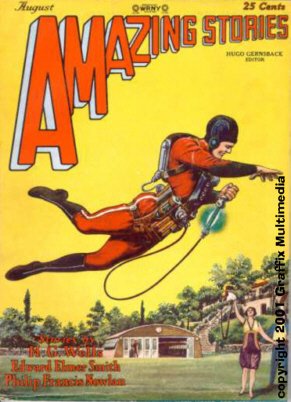
 The first issue dated April 1926 was a landmark in magazine & pulp publishing. With cover art by the legendary artist & futurist Frank R. Paul. Paul came Gernsback's attention in 1913, just in time for the techno revolution during the dawn of the 20th century. Gernsback was publishing among other things Radio News & Science and Invention which had been renamed from the Experimentor which itself began in 1908 as Modern Electrics. When Gernsback noticed Frank Paul, he realized his technologically futuristic creations were perfect fit for the covers of these scientific magazines & the interior illustrations. Paul's intricate designs & his tremendous insight into the future of space travel made him one of the most popular cover artists of the time. Over the years he would illustrate hundreds of covers & inumerable interior illustrations to Gernsback Publications. Amazing Stories was an immediate hit becoming one of the highest selling magazines on the news stands quickly. It was no surprise, the authors contained within the covers of this pulp over the years are a science fiction hall of fame list in themselves. Also the cover art by Frank Paul was so compelling they helped to inflame the immagination of the reader. 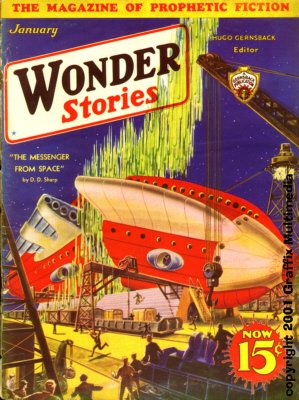
 Following Gernsback were a host of publishers looking to cash in on the SF craze. The most notable of these was Clayton Publications with it's legendary title, "Astounding Stories". Astounding was the first sf pulp title to utilize top rated authors. Ray Cummings, Donald Wandrei, E.E.Smith, Otis Adelbert Kline, A.Hyatt Verrill, Jack Williamson, Arthur Burks and many more. As a result it became the most popular sf pulp from the 1930's until the 1970's. The cover artists were also among the best. H.W.Wesso illustrated many of the early issues, but other artists through the thirties & forties included Howard V. Brown, Hubert Rogers, Virgil Finlay, futurist Chesley Bonestell, Graves Gladney, William Timmins, Ed Cartier and on and on. A literal who's who of sf pulp cover art. The title was sold to Street & Smith in 1933. In 1936 Gernsback sold out his last running pulp title, Wonder Stories to Thrilling Publications and it became Thrilling Wonder Stories in August 1936 with a cover by Howard V. Brown. Pin up cover artist Earle Bergey & illustrator Rudolph Belarski were also hired to do covers and along with the stable of top authors Thrilling Wonder along with it's sister pulp Startling Stories became top sellers through the 30's & 40's. Detectives Inc.In 1920 while Gernsback was still publishing his pre-pulp magazines, another publisher was about to create a pulp that would change an entire literary line, the hard-boiled detective mystery. Journalist & literary giant H. L. Mencken and drama critic George Jean Nathan launched the Black Mask in April 1920. they had been publishing a pulp titled "Smart Set" which had been losing money, as well as other pulps, "Parisienne" and Saucy Stories which had been profitable. So popular wasBlack Mask's introduction that in less than 1 year (eight issues!) after it's debut they sold the magazine to the publishers Eltinge Warner and Eugene Crow for a whopping $12,500. A nice profit from their initial $500 investment. Though the first few years have many types of stories, it would only be a while longer before the main focus of the magazine became the detective mystery. In 1923 they published a story by author Carroll John Daly titled "Three Gun Terry". This story is recognized as the first full fledged hard-boiled detective mystery. 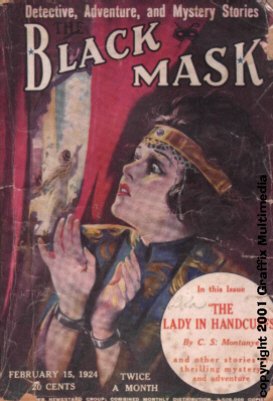
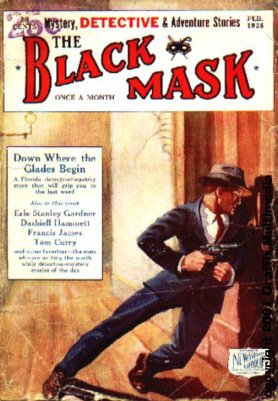 Soon Black Mask was becoming the premier detective story pulp & in it's pages began to appear the stories of Earle Stanley Gardner's "Perry Mason" & Dashiell Hammett's "Continental Op". The private detective was finally birthed into American culture & would forever change literature, radio & film. In 1926 Joseph T. Shaw was hired to edit the pulp. He is quoted as saying "We always held that a good story is where you find it regardless of author fame or medium of publication. It has been said that with proper materials available, a good mouse trap can be built anywhere."
next chapter: Heroes, Villains & Circus FreaksBibliography listing |
|
||||


This site created & maintained by Graffix
Multimedia ©1992-2014 no part may
be reproduced without permission of the author of this
site.